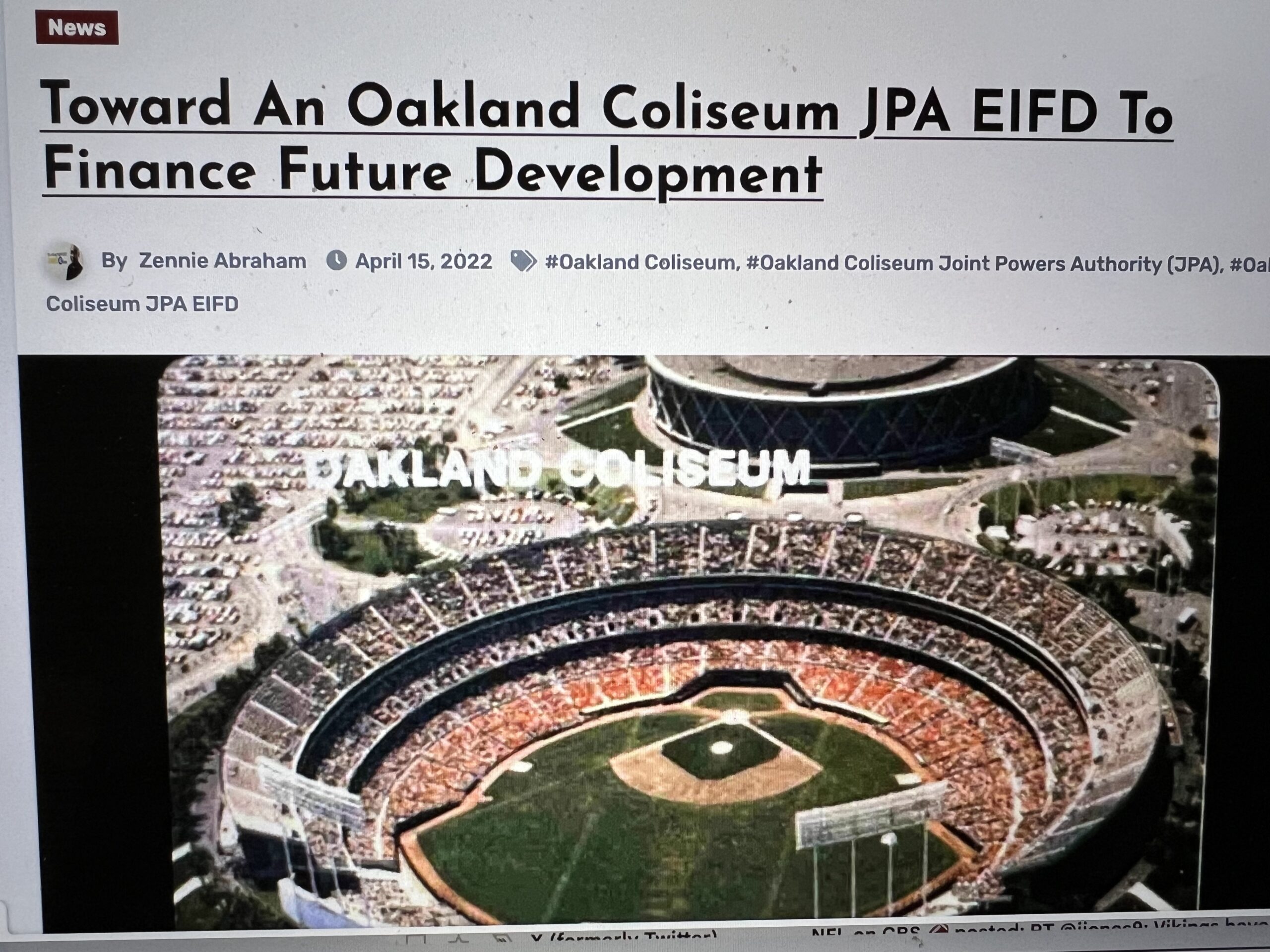
Oakland (Special to ZennieReport.com) – This post is a combination of two previous ones I wrote on this subject of developing an Enhanced Infrastructure Financing District or “EIFD” for the Oakland Coliseum. This idea of an Oakland Coliseum EIFD – and more specifically using tax increment financing – is something I have believed in for several decades. The need for diverse sources of money as the cost to develop new sports-oriented facilities has become ever more acute over that time. So here, I present the two sides of the coin: what an EIFD is, and how to start one, and then how it works, including what a budget would look like, including TIf revenue.
Author’s Note: This ZennieReport.com post is based on and expanded from “Toward An Oakland Coliseum JPA EIFD To Finance Future Development” by Zennie Abraham, April 15, 2022, in Oakland News Online.
The Oakland Coliseum Joint Powers Authority (JPA) can establish its very own Enhanced Infrastructure Financing District to help pay for Coliseum-related development projects.
The language from Enhanced Infrastructure Financing Districts Resource Guide is clear. It reads as follows:
What is an “Enhanced Infrastructure Financing District” (EIFD)
On January 1, 2015, Governor Jerry Brown signed into law, SB628, “Enhanced Infrastructure Financing Districts” (EIFDs) which allows for a separate government entity1 to be created by a city or county within a defined area to finance infrastructure projects with community-wide benefits. EIFDs are an upgraded version of the Infrastructure Financing District (IFD). When formed through a Joint Powers Authority (JPA), an EIFD can be established without voter approval. EIFDs can finance public infrastructure projects, as well as private child care centers, affordable housing and parking facilities. While no voter approval is required to form an EIFD, a 55% affirmative vote is required for the EIFDs issuance of bonds.2 Through the establishment of a Joint Powers Authority, the EIFD accommodates more flexible institutional collaborations.
UPDATE: Public Vote No Longer Required For EIFD To Issue Bonds
As of California Assemblymember Phil Ting’s California Assembly Bill 116 (2019), a public vote of property owners in an EIFD is no longer required. Here’s the Bill’s language:
Existing law authorizes the legislative body of a city or a county to establish an enhanced infrastructure financing district, with a governing body referred to as a public financing authority, to finance public capital facilities or other specified projects of communitywide significance. Existing law requires a public financing authority to adopt an infrastructure financing plan and hold a public hearing on the plan, as specified. Existing law authorizes the public financing authority to issue bonds for these purposes upon approval by 55% of the voters voting on a proposal to issue the bonds. Existing law requires the proposal submitted to the voters by the public financing authority and the resolution for the issuance of bonds following approval by the voters to include specified information regarding the bond issuance.
This bill would instead authorize the public financing authority to issue bonds for these purposes without submitting a proposal to the voters.The bill would require the resolution to issue bonds to contain specified information related to the issuance of the bonds. The bill would also require the public financing authority to hold 3 public hearings on an enhanced infrastructure financing plan, as specified. The bill would also make conforming changes.
Source: https://leginfo.legislature.ca.gov/faces/billTextClient.xhtml?bill_id=201920200AB116
Oakland Coliseum Joint Powers Authority Can Form Its Own EIFD: Oakland Coliseum JPA EIFD
The idea here is to form an Enhanced Infrastructure Financing District of all of the property within a boarder formed by 66th Avenue, San Leandro Boulevard, 98th Avenue, and The San Leandro Channel Inlet, and including the Oakland Airport Business Park. A tax increment financing zone would be established using that EIFD boundary. Within it, not only would we capture property tax revenue for use in a planned Coliseum City Complex bond issue, but any special fees like those from stadium seat licenses, and any special surcharge that may be established.
The objective of creating this EIFD and forming the Coliseum JPA Public Financing Authority and Coliseum JPA Infrastructure Financing Plan, is to cause the creation of a flow of funds that could be applied to what development plans the African American Sports and Entertainment Group (AASEG) create. The establishment of the Enhanced Infrastructure Financing Districts will help accelerate overall project financing, and establish a basis for the payment of development project administrative costs using a small percentage of TIF revenue money.
The Coliseum JPA would have to engage the County of Alameda and the City of Oakland’s participation, as well as BART and AC Transit and EBMUD taxing agencies. Given the nature of the Coliseum property and lands that would be in the EIFD, and the BART and AC Transit operations within the EIFD, planning for the use of expected revenues to be able to catalyze BART and AC Transit program plans in the EIFD is possible.
The EIFD would be large enough to capture revenue for, and install infrastructure improvements to combat, expected future sea-level rise. Meanwhile, there would be enough revenue generated to cause the construction of extremely affordable housing in the EIDF.
The Next Step Toward A Coliseum EIDF: Resolutions To Council
The next step are two resolutions to present intent to, then establish, the Coliseum Public Financing Authority (CPFA) and for it to hire a consulting firm and secure relevant City of Oakland and County of Alameda staff to design and present the EIDF boundary, as well as work with the County of Alameda in the boundary formation process. Before the Infrastructure Financing Plan can be written, the Public Financing Authority (PFA) must be established first, by law.
The next determination is who sits on the Coliseum Public Financing Authority or CPFA.
Coliseum Public Financing Authority Should Have A Seat For OUSD Board Member
The recommendation here is that the PFA include members of BART and AC Transit Board as they represent the impacted taxing agencies, as well as the Oakland Unified School District Board, AKA OUSD, because, while the law protects OUSD from being included in the property tax give to the Public Financing Authority, what the PFA plans impacts OUSD. So, OUSD should have representation in order to assure a redevelopment plan that meets the need of the school district. Such a consideration is not prohibited by California law.
Coliseum PFA Board Composition
The Coliseum Public Financing Board should consist of its own Executive Director, The Coliseum Joint Powers Authority Executive Director as second in command, the City and County JPA elected officials, representatives of BART, AC Transit, EBMUD, and OUSD, two of the four representatives of the business community that sit on the JPA, and one seat representing a staffer or public official from the Port of Oakland, one seat representing the Oakland Airport Business Park, two seats each representing AASEG and Oakland A’s, and one seat representing team tenant organizations, one seat representing Coliseum Entertainment Service Providers, one seat representing Visit Oakland.
Why Such A Large PFA Board? To Serve As A Task Force For The Development of The Oakland Coliseum Grounds
The reason for a 19-person board is simple: to meet the representation needs caused by the scope of the project, and the need for the Oakland Coliseum task force long wished for but never created. Indeed, the original enabling legislation of the Coliseum JPA called for 20 board members. The closest organization the City of Oakland has had was the 45-board-member Oakland-Alameda County Coliseum Sports Commission formed by this blogger in 1999 and for the purpose of creating Oakland’s bid to host Super Bowl XXXIX, and draw and produce sports events to be held in Oakland.
Coliseum JPA / City / County Resolution To Transfer Bond Issuance Capacity To Coliseum Public Financing Authority
Another task that should be done as part of the approval of the formation of the PFA is a resolution for the City of Oakland and the County of Alameda and the Coliseum JPA to transfer bonding capacity to the Coliseum Public Financing Authority. In this was the Coliseum PFA would have the official assurance that its bonds could be floated with the backing of the City and the County unless a specific bond language prohibits such an arrangement.
To understand the role of the PFA with respect to the City and County, refer to MOUNT SHASTA PUBLIC FINANCING AUTHORITY SERIES 2019 REVENUE BONDS (CITY AND WW TREATMENT PLANT SOLAR PROJECT) BANK QUALIFIED.
Source: http://cdiacdocs.sto.ca.gov/2019-1853.pdf. Also $10,025,000 OAKLEY PUBLIC FINANCING AUTHORITY 2016 LEASE REVENUE BONDS Source: http://cdiacdocs.sto.ca.gov/2016-2917.pdf .
It’s also important to note that the Coliseum PFA can’t levy taxes for a bond issue, only the City and the County can do that. That said, the Coliseum PFA is not prohibited from establishing user fees for activities within its boundaries. Remember that user fees are charges for service provided by a governmental agency to the public. Arguably, the very ownership of and to a degree operation of facilities by the Coliseum PFA would allow the creation of user fees for the public to pay, as needed.
The Coliseum EIFD Infrastructure Finance Plan – Possible Configuration
The Infrastructure Financing Plan components consist of the following:
- Map and Legal Description
- List of Facilities and Programs
- Tax Increment Revenue Projections
- Financing Plan
- Fiscal Impacts on Affected Taxing Entities
- Date District will Cease
- Replacement Housing Plan
- District Goals
- Tax Increment Limits
Source: https://caled.org/how-to-create-an-eifd/
Also, The City of Napa provides an excellent online example of how they produce an EIFD and the IFP for it.
All of those components can be assembled for an IFP in less than a month. To date, in eight years of the EIFD law that was established in 2015, the City of Oakland has not started a process to create one, and so has not written an IFP.
Beyond that, the Infrastructure Financing Plan would have two primary parts: one for a “wish list” of projects deemed of community-wide significance, and the the other for the AASEG project. The “wish list” must and will complement the AASEG by calling for needed sea-level rise fixes, small business and affordable housing subsidy programs, and street and road improvement, as well as the BART and AC Transit projects. Again, the Infrastructure Financing Plan work should not start until the PFA is approved, funded, and staffed.
Note: AB 336, which was also signed on June 28th 2021, will allow any member of the legislative body of a participating affected taxing entity who serves as a member of the PFA of an EIFD, to serve as a member of the governing body of a Joint Powers Authority (JPA) where the taxing entity is a member. This bill eliminates potential conflicts in current law against public officials holding incompatible offices. Incompatible office law generally prohibits a public officer, including an appointed or elected member of a governmental board, commission, committee, or other body, from simultaneously holding two public offices that are incompatible. AB 336 has the potential to lower transactional costs of an EIFD and may increase efficiency by clarifying the roles of board members.
In closing, establishing the Coliseum EIFD will unlock and speed up the overall Oakland Coliseum development process.
How To Create An Oakland Coliseum JPA EIFD
Oakland (Special to ZennieReport.com) – This presentation before the Oakland-Alameda County Coliseum Joint Powers Authority is written to expand on the October 15th, 2023 Oakland Coliseum JPA EIFD (Enhanced Infrastructure Financing District) Discussion. It presents a step-by-step process drawn primarily from EIFD documents for San Jose, Santa Rosa, Sacramento, as well as California EIFD legislation SB628 Bealle (2015), SB293 Skinner (2019), AB464 Mullen (2021), and AB336 Villapudua (2021).
This presentation is also the first document of its kind to present a step-by-step process and takes AB 464 Mullin (2021) into account.
AB 464 Mullin allows the use of tax increment financing revenue to finance programs to help small businesses in the EIFD to recover from the COVID-19 Pandemic, non-profit community facilities,and projects deemed of community-wide significance (depending on how the Infrastructure Financing Plan is written),
Regarding tax increment financing, or “TIF”, this presentation was also based on a calculation process that mates TIF revenue with municipal bond sizing: the TIF revenue stream and debt coverage ratio determine the size of the bond to be issued. The Public Financing Authority can then determine what projects can “fit” in that revenue envelope as a prelude to the creation of the Infrastructure Financing Plan or “IFP” and the bond issue, or bond issues.
California EIFD Law Established In 2014
The Enhanced Infrastructure Financing District or EIFD was established in 2014 by California Senator Jim Bealle and signed into law by California Governor Jerry Brown. It is designed to reintroduce tax increment financing to California municipalities to be used as a tool to catalyze the creation of various types of development.
This ZennieReport.com post points to a special law AB 336 from 2021, which allows members of a joint powers authority to sit on the Public Financing Authority of an Enhanced Infrastructure Financing District. In other words, for the organization to be both JPA and EIFD. It’s also based on Section 53398.51 of the California Code, and in the following way: If a JPA decides to establish an EIFD, then Section 53398.51 of the California Code says it must first create a Public Finance Authority containing its own governing board.
California State law is more specific about the Public Finance Authority’s board structure than that for a JPA. Assuming that two or more of the public agencies making up the JPA wishing to create the EIFD themselves have taxation power, then the PFA’s board must be composed of a majority of the governing legislative bodies (city council, county boards of supervisors, etc.) of every participating government.
That is, a majority of the members of the legislative bodies of the cities, counties, and special districts comprising the board must also serve on the PFA (and it is uncompensated service, though reimbursement is allowed)
This document, this post here at ZennieReport.com, lays the ground work for the creation of the Oakland Alameda County Coliseum JPA / EIFD. Basically, the PFA is the governing body of the EIFD within the JPA.
Steps Toward An Oakland Coliseum JPA EIFD
Step One: Formation Team:
1. Economic Development Representative
2. Legal Counsel
3. Financial Advisor
4. TIF Consultant
5. Oakland Coliseum JPA Exec Dir, Manager, City, County, Business Rep
6. Business Task Force (Advocacy Group).
Step Two: Formation Team Work:
1. Define/Refine Boundaries
2. Develop Preliminary Priority Project Funding Cost Estimate
3. Determine Bond Size Requirement For Project
4. Calculate Tax Increment Revenue from EIFD Boundary
5. Determine Size of Bond Issue, Bond Issue Debt Service Based on TIF Revenue & Debt Cov Ratio, Bond Interest Rates
6. Size Preliminary Priority Project Funding Cost Estimate with respect to TIF Revenue
7. Identify Funding Sources in Addition to Tax Increment
Step Three: Conduct Outreach:
1. Electeds
2. Other Taxing Entities
3. Affected Residents and Property Owners
4. Explore potential projects to be funded by the EIFD that would entice participation of the County or other taxing agencies
5. Educate stakeholders about EIFDs – not a new tax, not a lien on property
6. Identify property owners who will advocate for formation (Here’s where the Business Advocacy Group helps).
Step Four: Start Public Financing Authority
1. Determine who sits on Public Financing Authority, (Merge Coliseum JPA Members with New Seats) – for City Council vote as part of PFA Resolution.
2. Assemble Resolution of Intention and PFA Formation documents (based on Santa Rosa EIFD Model – source here):
A. Staff Report On EIFD Formation To City Council
B. Resolution of Intention (Approved Boundaries and list of improvements and projects) for City Council Vote
C. Public Financing Authority Resolution including Infrastructure Financing Plan for City Council Vote.
D. City Council votes on B and C which establishes PFA
Board of Supervisors & City Council:
– Each adopt Resolutions approving the Infrastructure Financing Plan
Statement of Boundary Change
– Filed by Public Financing Authority with CA State Board of Equalization
No election is required unless 25% of property owners protest at third PFA public hearing.
– An EIFD is abandoned if over 50% of property owners protest the formation.
– JPA approves the IFP by resolution
– The PFA adopts the IFP and approves the Resolution of Formation establishing EIFD at the third public hearing.
• PFA files “Statement of Boundary Change” with California Board of Equalization
NOTE: Unlike old redevelopment districts that utilized tax increment financing, there is no blighted area requirement to establish an EIFD
Step Seven: EIFD Bonds
– WHO: Public Financing Authority makes the decision to sell bonds
– WHEN: Public Financing Authority may decide to sell bonds based on tax increment revenue versus project cost need as expressed in IFP
– Minimum debt service coverage is 125%
– Bonds cannot be sold until predetermined level of tax increment is generated that’s sufficient to meet annual bond debt service. But tax increment revenue can be collected from the start of establishment of the EIFD and the PFA. Tax increment revenue can also be collected on a pay-as-you-go basis.
A Follow-Up ON EIDFs and Pay-Go TIF Revenue Collection
A follow-up is important here. Prior to 2017, EIFDs were not able to collect tax increment revenue on a a pay-as-you-go basis, but after 2017 and the amendment to Infrastructure Financing Plan legislation, TIF revenue could be collected on a “pay-go” basis as long as it was described in the Infrastructure Financing Plan. For example, The Infrastructure Financing Plan for the Samoa Peninsula Enhanced Infrastructure Financing District, released in 2022, says the following:
A plan for financing the public facilities to be assisted by the district, including a detailed description of any intention to incur debt. Section 5.3 of this IFP includes a plan for financing the public facilities to be assisted by the District. The PFA governing the District intends to incur debt only when it is financially prudent to do so. It is estimated at this time that 53.5 million (in present value dollars) will be contributed by the EIFD to public improvements through a combination of tax increment bond or loan proceeds (multiple issuances may be necessary) and pay-as-you-go tax increment funding over the District lifetime
https://humboldtgov.org/DocumentCenter/View/105672/Resolution-Adopting-the-Infrastructure-Financincing-Plan-for-the-Samoa-Peninsula-Enhanced-Infrastructure-Financing-District
A related note regards the elimination of voter approval before an EIFD can issue bonds: EIFD Requirement Removed for Voter Approval Before Issuing Bonds – On Wednesday, October 9, 2019 Governor Newsom signed AB 116, Authored by Assemblymember Phil Ting, AB 116 removes the requirement for Enhanced Infrastructure Financing Districts (EIFDs) to receive voter approval prior to issuing bonds. CALED championed this under SB 128 (Beall), and we were glad to see it picked up in this budget trailer bill.
https://caled.org/legislative-matters/
So, if you see the document called “RESOURCE GUIDE TO EIFDs by the California Community Economic Development Association” and dated February 2016, don’t use it, because it has the old information regarding pay-go.
– HOW: Bonds are secured only by tax increment generated within the EIFD, NOT by the City’s General Fund.
NOTE: Proceeds may be utilized to fund any public improvement with a useful life of 15 years or more that provide community benefit
Step Eight: EIFD Eligible Public Improvements
• Roads, highways, streets/streetscapes, parking facilities, and transit facilities
• Affordable housing
• Small businesses impacted by COVID-19 Pandemic
• Internet access services
• Childcare facilities
• Libraries
• Parks, open space, and recreational facilities
• Improvements related to fighting climate change
• Brownfield restoration and other environmental mitigation
• Transit priority facilities
• Sewer, reclamation, and water facilities
• Solid waste facilities
• Flood control facilities, retention bases, and drainage channels
Following those steps will result in an Oakland-Alameda County Coliseum JPA / EIFD. It will be an exciting procedural first step toward the eventual reinvestment wave it will create in Oakland, starting with the Coliseum Area and East Oakland.
Possible Coliseum JPA / Enhanced Infrastructure Financing District Boundaries, Base Year Assessed Value, And Expected Bond Proceeds
What was presented is the legal skeleton that will establish the Coliseum JPA EIFD, but that does not answer the question: how much money can the Enhanced Infrastructure Financing District generate to meet the legal objectives of AB464 Mullin:
California Assembly Bill 464, authored by Assemblyman Kevin Mullin, expanded the scope of Enhanced Infrastructure Financing Districts (EIFDs). Chaptered into law, the legislation granted local governments the flexibility to utilize EIFD funds to finance small business commercial properties and nonprofit community facilities delivering health and social services.
Key operational details of the legislation include:
- Small Business Support: Allows EIFDs to help small businesses acquire, construct, or renovate their own commercial structures, facilitating economic recovery. [1]
- Nonprofit Facilities: Authorizes districts to fund physical facilities for nonprofit organizations that provide youth, health, homeless, and social services. [1, 2]
- Local Control: Enhances existing EIFD laws to provide cities with greater flexibility in combating pandemic-related economic impacts and community facility shortages. [1]
The Main Objective Of The Law Is Business Revitalization But It Can Support The Formation Of A City Within A City
The idea of AB464 Mullin is to steer money to businesses that were financially and physically harmed during the Pandemic. Much of Oakland’s central business district has been descimated by The Pandemic. But the Coliseum Property where new development will be concentrated, does not provide housing at this point in time. The total number of small businesses can be counted with two hands. Thus, the new sports-focused structure and other new land uses would be generating tax increment revenue for “physical facilities for nonprofit organizations that provide youth, health, homeless, and social services” for new residents. The question is how much in tax increment financing revenue are we talking about? To know that, you have to know what tax increment financing is. I will explain.
Tax Increment Financing or “TIF” is a method of fundraising I learned about at the behest of my boss, the late Assistant City Manager Ezra Rapport, in 1987. He asked me to learn it “cold” because he needed to know what the revenue production would be from a development plan presented to stop The East Bay Municipal Utility District (EDMUD) from building a wet-weather water storage facility. EBMUD’s development would effectively choke-off land in Emeryville that could be built to a higher-and-better use – one that threw off more tax revenue from TIF from the private sector versus the public sector represented by EBMUD, which does not pay property taxes on. infrastructure developments.
So, TIF establishes a zone that is made by boundaries surrounding the area of concern where development and improvements are to be made, and sets what is called a “base year of assessed value”. Then, the very next year marks the total assessed value for the first year of the TIF Zone. The first year of property tax is arrived at by:
- Taking the first year of total assessed value for the TIF Zone, and
- Subtracting the “base year of total assessed value” or the previous year, which gives us..
- The first year of property tax paid to the Public Financing Authority.
- The second year’s amount of property tax paid to the Public Financing Authority is arrived at by estimating the second year of total assessed value of the land in the TIF Zone. Model builders often just apply a forecast of rate of increase in the total assessed value of the land in the TIF Zone, then subtract the “base year of total assessed value”.
- We do this for each year “going up” to 45 years, but each year we take the total assessed value for that year and subtract the base year of total assessed value”.
- We also subtract that tax amount calculated for the “base year of total assessed value” from the total assessed value for that year in the future. We do that so we realize what is called the “incremental growth, and the Oakland General Fund, The County of Alameda, and The EBMUD Flood Control and the School District get their payments.
- After the base year, only the Oakland Unified School District gets it’s cut of 40 percent of the base year dollar of total assessed value times the rate of growth for each year after that. The remaining 60 percent percent of the base year dollar of total assessed value times the rate of growth for each year after that is used as part of the tax increment revenue calculation.
To make that revenue substantial, it has to be gathered over a wide land area. A rule of thumb I have established is to target the TIF revenue need as a way of determining the size of the TIF Zone. So I if I need over $1 billion in bond proceeds then I need to have a TIF Zone of at least $2 billion in total assessed value at the base year.
In the case of the Coliseum JPA EIFD, we’re looking at a TIF Zone that should starts to the north of the Coliseum at 50th Avenue, go down San Leandro Boulevard, turn at the Oakland – San Leandro Boarder, follow the shoreline of the San Leandro Channel and the Oakland Estuary, and then turn back in at 50th Avenue.
That comprises the entire flat land area of East Oakland, and includes part of the Oakland Airport land. The Port of Oakland may want to carve out that portion, but I think a better idea is to include the entire facility to plan another project separate from the Coliseum but complementary to it in use. Overall, the base year total assessed value for the TIF Zone may come in at around $4 billion. But using that, and then assuming a rate of growth in assessed value of 3 percent will yield a TIF Total Revenue of $3.2 billion. The debt coverage ratio is point-five aka .5, so the total proceeds would. be $1.6 billion for the project. That is not bad considering we have not included the assessed value of what we plan to build.