



Oakland (Special to ZennieReport.com) Josh Rowan, once the head of ATLDOT, where “DOT” stands for Department of Transportation, has the same role in Oakland and has been here for almost a year, now. Mr. Rowan is known for creating a detailed argument for a transportation initiative, and so Oakland’s lucky to have him.
But the luck runs out because of Oakland’s bad economic conditions, worsened by the City’s sudden loss of memory of how to do business retention and business attraction. The result is a City of Oakland management fearful of letting the Measure U Transportation and Housing Fund Bond Issue for fear of default.
To continue to push for the Measure U Transportation and Housing Fund Bond Issue, Josh Rowan and his OakDOT staff reposted a February 11th, 2025 report that was for the Public Works & Transportation Committee Meeting of March 25, 2025 for presentation at Monday’s April 14, 2025 Oakland City Council Meeting. It doesn’t have an official title., so I’ll give it one: The Case For The Oakland Mesure U Bond Issue.
After reading it, one message is clear: The Measure U Transportation and Housing Fund Bond Issue is really an investment in key population building that can positively impact economic growth, thus improve the environment for the paying of the bond debt. Empower Oakland did not make what is basically a Keyensian Economics argument, just attacked the logic of holding off due to economic conditions, but I am making one. And again, the reason is simple: this can improve economic conditions and be paired with an economic development business retention and attraction program, to maximum effect.
The Case For The Oakland Mesure U Bond Issue by Josh Rowan, OakDOT Director
The Department of Transportation (OakDOT) uses infrastructure bonds to deliver its Capital Improvement Program (CIP). The largest expenditures in the CIP are for the Five-Year Paving Plan and grant matching for complex street reconstruction projects. The department has spent and encumbered more than 95% of the $350 million available for transportation under Measure KK. Measure U, Measure KK’s successor, included $290 million for transportation, but OakDOT has not received any Measure U funds to date.
As of this report writing, until a new bond sale of Measure U is completed, OakDOT cannot initiate new contract paving projects and is in danger of delaying grant-funded, shovel-ready streetscape projects.
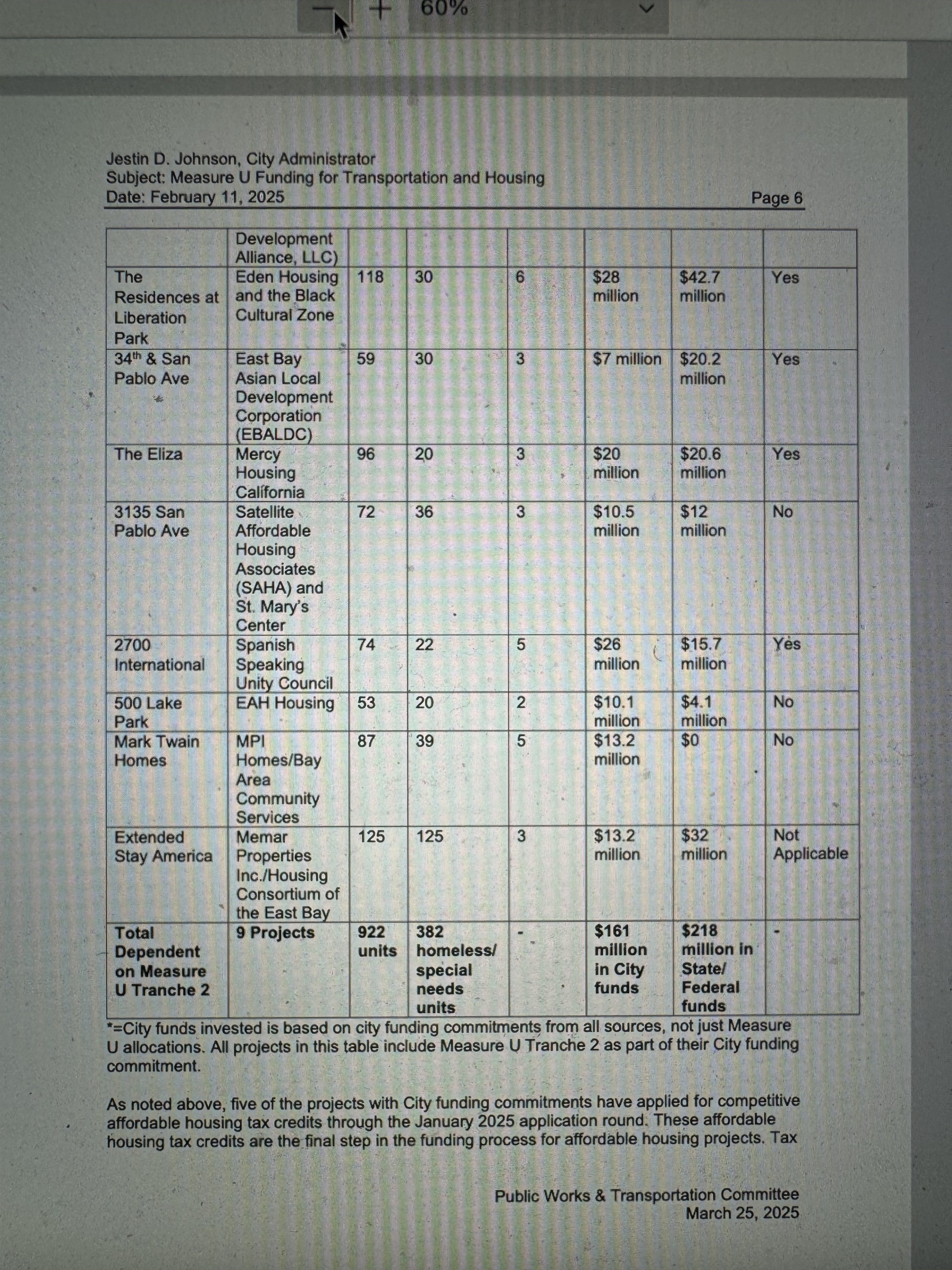
The Department of Housing & Community Development (HCD) uses infrastructure bonds to fund its capital commitments for affordable housing. HCD has made funding commitments to 9 projects that are dependent on a 2025 bond issuance. These projects contain 922 units, including 257 homeless housing units. Without a 2025 bond issuance, the impact on these projects will be severe. Five of these projects applied for affordable housing tax credits in January 2025, and if awarded tax credits they must either return millions of dollars in tax credit funding by late April, begin construction in 180 days, or face severe penalties that would likely kill the project and hamstring the affordable housing developer’s future work. Without a 2025 bond issuance, the other HCD pipeline projects with a funding commitment would be unable to apply for affordable housing tax credits.
This would force project delays of at least a year and lead to project cost escalation. This cost escalation would need to be offset by future City funding commitments, reducing resources available to address the $340 million in unfunded affordable housing projects currently on a waitlist for City funding. Without a 2025 bond issuance, other HCD programs, including the Rapid Response Homeless Housing (R2H2)program, Acquisition and Conversion to Affordable Housing (ACAH), and Preservation Notice of
Funding Availability (Preservation NOFA) would all experience delays in their ability to fund projects. Over the long term, the failure of the City to promptly honor its funding commitments would deal grave damage to the credibility of the City’s commitments, reduce the number of affordable housing developers willing to work in Oakland, and reduce Oakland projects’ competitiveness for State-level affordable housing resources.
BACKGROUND / LEGISLATIVE HISTORY
On December 21, 2021, the City Council approved a resolution establishing the current pavement management program, referred to as the 2022 5-Year Paving Plan (5YP) (Resolution No. 88975 C.M.S.). Measure KK was approved by the voters of Oakland in November 2016 to fund $600 million in vital infrastructure maintenance improvements, including $350 million for streets and sidewalks, of which 95% has been spent and encumbered. A subsequent infrastructure bond measure, Measure U, was approved by voters in 2022 and includes $290 million for transportation-related projects. However, OakDOT has yet to receive any Measure U funds.
Under the FY23-25 Capital Improvement Program, work supporting 5YP implementation was originally funded by infrastructure bond funds, including Measure KK and Measure U. The FY25 budget for Measure U for Transportation was originally established at $55.1 million, with street resurfacing as its largest component at $51.75M. This budget was then reduced to $0 as part of the FY25 contingency budget that went into effect in October 2024.
Following these reductions, OakDOT, Finance and CAO took various administrative actions in Fall 2024 to minimize impacts to the paving program. These included reallocating $5M in funds from OakDOT projects with excess near-term cash, reallocating $12.7M in Measure KK funds from Oakland Public Works CIP projects with excess near-term cash, and seeking Council Approval to appropriate $3M in Measure BB Fund Balance towards the paving program. These measures allowed key paving contracts to proceed. However, there is no available funding for further administrative actions. As a result, as of January 2025 all pending paving projects have been deferred until a bond sale of Measure U is completed.
The Council has authorized the use of Measure U bonds for HCD’s affordable housing programs on several occasions. Funding was authorized for the projects now at risk from a delayed bond issuance via Resolution No. 90118 C.M.S., Resolution No. 90419 C.M.S., and Resolution No. 90552 C.M.S. Funding from Measure U was authorized for HCD’s 2023-24 New Construction Notice of Funding Availability (NOFA), HCD’s 2024-25 New Construction NOFA, Acquisition and Conversion to Affordable Housing (ACAH) program, Rapid Response Homeless Housing (R2H2 program) and Rehabilitation NOFA.
On November 12, 2024, the Council adopted Resolution No. 90510 C.M.S., which authorized funding for an affordable housing developer to acquire the Extended Stay America and ultimately convert the property into 125 units of Permanent Supportive Housing
ANALYSIS AND POLICY ALTERNATIVES
Impacts on Transportation
Table 1 below represents OakDOT’s unconstrained capital need for Fiscal Year 2025-2026, the
first year of the upcoming biennial budget.
Table 1: FY26 Transportation CIP Unconstrained Need
FY26 Unconstrained Capital Need Amount (in millions)
Street Resurfacing $ 91.3
Curb Ramps & Sidewalks $ 19.0
Complete Streets Capital/Grant Matching $ 24.7
Bike & Pedestrian Plan Implementation, Traffic
Signals, Safe Routes to School/Neighborhood Traffic
Calming
$ 3.0
Bridges & Structures $ 5.7
Total $ 143.7
FY25-27 budget instructions from the Finance Department directed OakDOT to assume a worst-case scenario where bond sale will not take place in the first year of the 2-year budget (i.e.; FY26), which means the agency can only use non-bond funding to support its CIP. Finance and the City Administrator’s Office are however actively working to ensure such a sale does occur in FY 26. OakDOT and Finance estimate that a maximum of $31.0M in one-time non- bond funding will be available for programming in the FY26 budget, as shown in Table 2. This includes all available fund balance from both Measure BB transportation sales tax and state gas tax funds. If all available non-bond funds are budgeted to capital projects, OakDOT would have a deficit of $112.7M compared to the unconstrained capital need.
Table 2: Estimated One-Time, Non-Bond Funds As Of 6/30/25
Category Amount (in millions)
Measure BB/VRF fund balance (Funds 2215/2218/2219) $ 8.5
Gas Tax fund balance (Funds 2230/2232) $ 14.0
Grant matching carryforward from FY 24-25 $ 6.5
Transportation Impact Fees carryforward from FY 24-25 $ 2.0
Total $ 31.0
OakDOT recommends that available non-bond capital funds be prioritized to: (1) continue to fund personnel and materials for in-house paving operations; and (2) provide local matching funds for capital grants with executed grant agreements. Table 3 identifies a high-level framework for approximate expenditures under this scenario.
Table 3: FY26 Capital Budget Framework (No Bond Funds)
Category Amount (in millions)
Personnel costs for bond-funded staff $ 6.5
Materials for in-house paving/curb ramps $ 4.3
Complete Streets Capital/Grant Matching $ 14.2
Capital programs (bike/ped, signals, traffic calming) $ 2.0
Bridges & Structures $ 4.0
Total $ 31.0
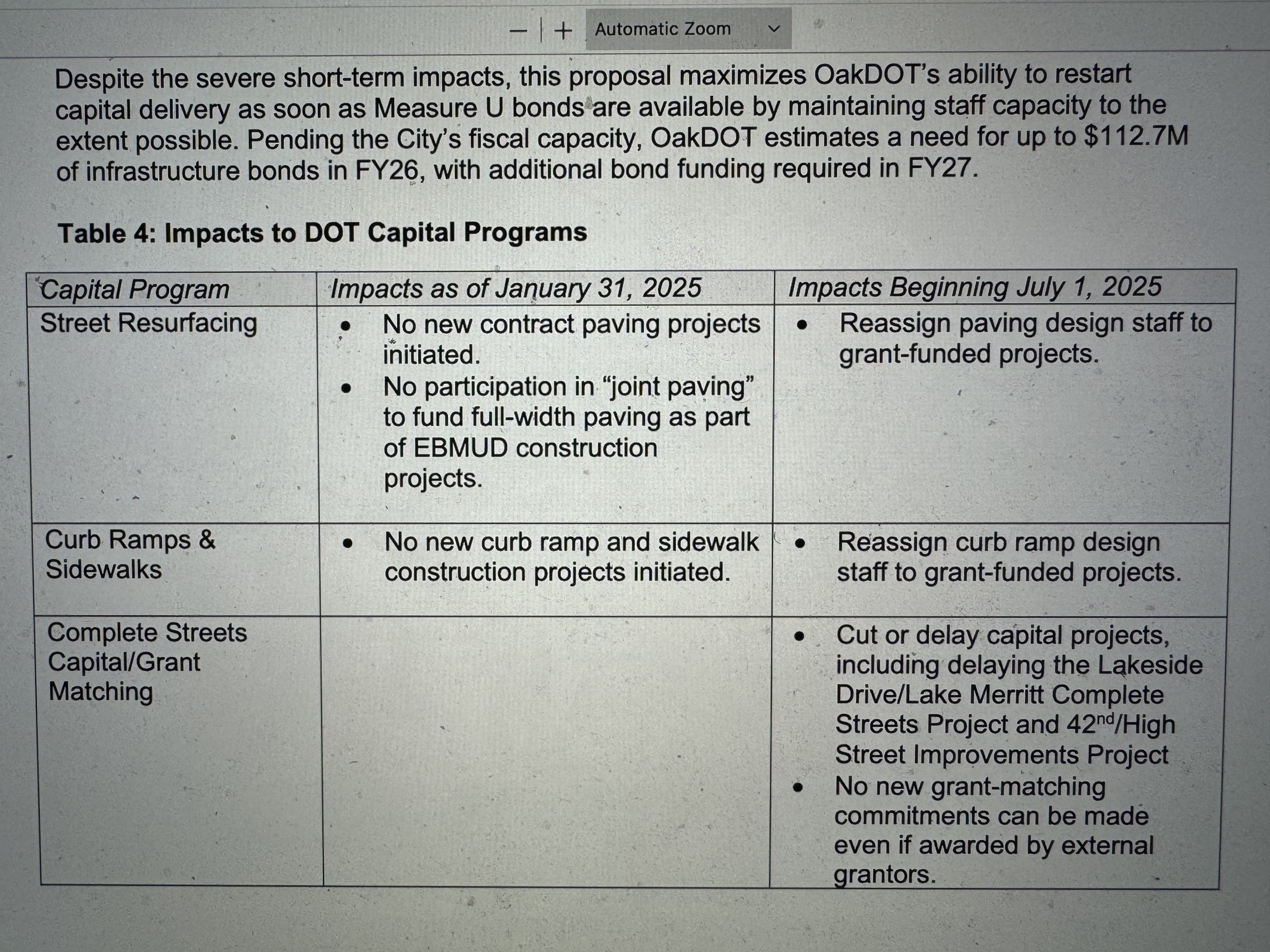
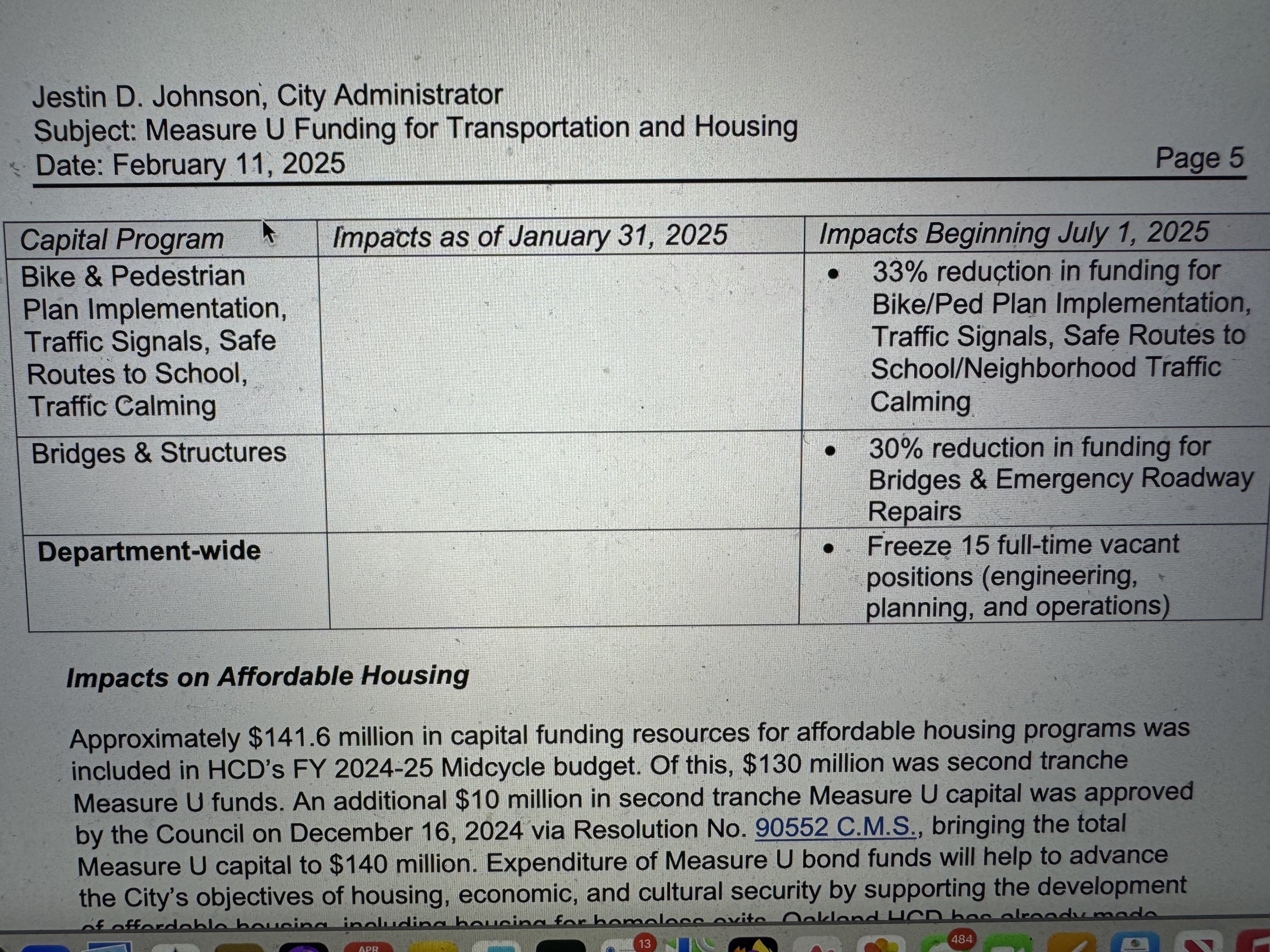
As Table 4 details, there are existing impacts to OakDOT’s paving, curb ramps, and sidewalks capital programs associated with the delay of the Fall 2024 bond sale. Extending the delay through 2025 would result in deeper impacts to OakDOT’s overall capital delivery program:
- Continued freeze on contract paving construction
- Reassign pavement engineering staff to other OakDOT engineering sections
- Continued freeze on contract curb ramp and sidewalk construction
- Reassignment of curb ramp design staff to other OakDOT engineering sections
- FY26 paving mileage estimated to be 8 miles
Despite the severe short-term impacts, this proposal maximizes OakDOT’s ability to restart capital delivery as soon as Measure U bonds are available by maintaining staff capacity to the extent possible. Pending the City’s fiscal capacity, OakDOT estimates a need for up to $112.7M of infrastructure bonds in FY26, with additional bond funding required in FY27.

Impacts on Affordable Housing
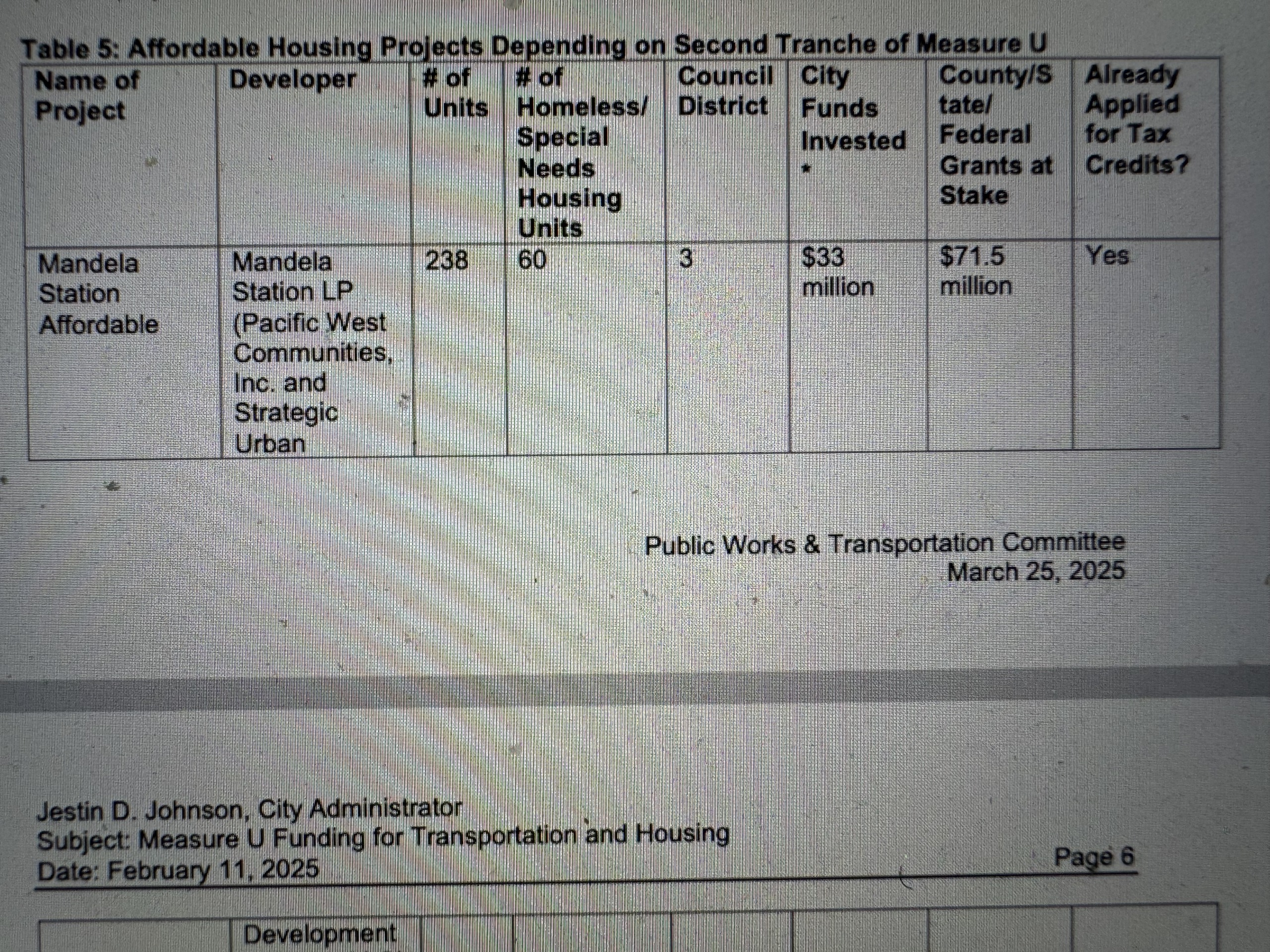
Approximately $141.6 million in capital funding resources for affordable housing programs was included in HCD’s FY 2024-25 Midcycle budget. Of this, $130 million was second tranche Measure U funds. An additional $10 million in second tranche Measure U capital was approved by the Council on December 16, 2024 via Resolution No. 90552 C.M.S., bringing the total Measure U capital to $140 million. Expenditure of Measure U bond funds will help to advance the City’s objectives of housing, economic, and cultural security by supporting the development of affordable housing, including housing for homeless exits. Oakland HCD has already made Measure U-based funding commitments to a wide range of affordable housing projects based on the Council’s previous authorization. These include projects selected from both the 2023-24 and 2024-25 New Construction NOFAs. A list of the projects known to be dependent on second tranche Measure U funding is included in Table 5.
Together, these projects contain 797 affordable housing units, including 257 special needs/homeless housing units. This list does not include projects that will be affected in the Acquisition and Conversion to Affordable Housing (ACAH) or Preservation programs. While the non-availability of bond funding would severely impact the ACAH program, second tranche Measure U funding has not yet been allocated to
specific projects in that program.

credit funding is highly competitive, and if awarded, the projects in question will have 180 days from award date to begin construction or a maximum of 20 days from the award date to return the award without penalty (this 20-day deadline is expected to be in late April 2025). If a project fails to return their award within the 20-day period and fails to achieve the 180-day deadline to begin construction, the following consequences take effect:
1) The State will immediately claw back the awarded tax credit allocation.
2) The State applies a major scoring penalty to all applications by the affordable housing developer for tax credit allocations for a two-year period. The penalty is sufficiently severe that it will effectively disqualify the developer from receiving any tax credit allocations for two years. This would be true for all projects in the developer’s development pipeline, not just the individual project that failed to meet the construction start deadline.
3) Most state and federal grants for affordable housing construction have deadlines to expend the funds and/or begin construction prior to being disencumbered. A two-year delay to the project beginning construction could jeopardize existing state and federal funding commitments to the project. If a two-year delay causes state or federal grants to be clawed back, this may set off a chain reaction of lost funding sources for the project that results in the permanent death of the project. The City and the project developers are generally not allowed to move these state and federal grants to other projects, so
most of these scarce state and federal housing awards would be disencumbered and reallocated to other projects around the state.
If the City fails to have funds available by October 2025, the City will not be able to honor its prior funding commitment for any January 2025 tax credit round projects that receives a tax credit allocation from the State. This would prevent the project from closing its construction loan and therefore prevent the project from beginning construction. This would in turn trigger the severe consequences described above for any affected projects.
The failure of the City to honor its funding commitments for affordable housing would likely have a dire set of broader consequences. When a local government makes an “enforceable funding commitment” to an affordable housing project, as Oakland has for these projects, this is understood to be reliable such that the developer, when applying for tax credits, can commit to the timeliness deadlines.
As such, the State accepts the funding commitments made in these letters at face value when assessing the competitiveness of projects for State-managed resources like affordable housing tax credit allocations. If the veracity of an enforceable funding commitment by the City is uncertain, affordable housing developers would not be willing to take the risk of negative consequences and would instead prioritize future projects outside of Oakland. Such an outcome would reduce the quantity and quality of future affordable housing project candidates in Oakland.
If all of the affordable housing projects that applied for the January 2025 tax credit allocation round do not receive an award, HCD would likely be able to avoid a situation where its funding commitments are called on but not honored. However, this merely delays the issue, as there are two remaining tax credit funding rounds this year in May and September, and any winning project would be in the position described above when preparing to start construction in January 2026 or May 2026. To entirely avoid the issue would require asking the City’s funded projects to refrain from any future tax credit allocation applications for at least a year.
In addition to delaying hundreds of affordable housing units, such an extreme move would likely require
additional City investment in these projects to offset construction cost inflation, impacts of tariffs,
and the potential loss of state or federal grants that are at risk of expiring. Any additional City
investment in this existing set of projects would reduce the amount of resources available in
future to fund additional affordable homes from the City’s unfunded pipeline of $340 million.
If Measure U bonds are not issued by January 2026, the Extended Stay America project will be
unable to convert to 125 units of Permanent Supportive Housing as the project is dependent on
Measure U for the cost of the rehabilitation.
If Measure U bonds are not issued during Fiscal Year 2025-26, HCD will also be forced to delay the issuance of its Preservation Notice of Funding Availability (Preservation NOFA). The Preservation NOFA will be one of the only ways for older affordable housing projects to receive funding to replace aging building systems. The Preservation NOFA is also an opportunity to extend affordability covenants for older affordable housing that has expiring deed restrictions. If the Preservation NOFA is delayed due to a lack of Measure U bond availability, existing affordable housing tenants will suffer from an increased
likelihood of elevator failures, roof leaks, and other maintenance impacts.
FISCAL IMPACT
There is no direct fiscal impact associated with accepting this report. If Measure U bond issuance is delayed, construction cost escalation will generate significant additional costs for planned Measure U transportation and housing projects. From 2021-2025, the State of California Department of General Services’ “California Construction Cost Index” estimated that construction costs inflated by an average of 8.7% annually. While inflation fell in 2024, tariff- related uncertainty poses a severe threat to construction costs.
If Measure U-funded affordable housing projects were delayed by one year and experienced an 8.7% increase in project cost in line with recent trends, the City would need to increase its funding commitment to these projects. An 8.7% increase in the City’s existing investment in these projects would cost at least $14 million.
However, many of these affordable housing projects with Measure U funding commitments rely in large part on state and federal grants to cover the bulk of their project cost. These grants are not adjusted for inflation, and it would be difficult or impossible for many of these projects to reapply for more funding from the same grant. As a result, it is likely the City would need to support an outsized share of construction cost inflation.
To move the same pipeline of Measure U-funded affordable housing projects forward may require increased City funding commitments in the mid- to high-tens of millions range and would reduce the overall number of affordable units that will be created with Measure U dollars.
The City Administrators Office and Finance Department are actively working to ensure that the City is able to issue bonds in FY26 to avoid the negative financial and operational impacts noted in this report. In order to successfully sell bonds the City must demonstrate: stable governance and management, improved immediate financial position, and that it has a plan for sustained improvement in finances and reserves; in addition to completing the required legal disclosures and operational steps.
PUBLIC OUTREACH / INTEREST
Transportation and affordable housing are top infrastructure priorities for Oaklanders, as evidenced by the passage of Measure U in 2022. The delay of a bond sale risks eroding public trust by not delivering on promises made by the City in the Measure U ballot language, including creating affordable housing, repaving streets and improving traffic/pedestrian safety. According to the 2025 Budget Advisory Commission budget poll, 55% of residents identified “clean and well-maintained streets” and 39% of residents identified “affordable housing” as one of the most important priorities that make Oakland a place, they are happy to call home.
COORDINATION
The Budget Bureau has reviewed this report. City Attorney review is not required.
SUSTAINABLE OPPORTUNITIES
Economic: Delayed implementation of the City’s paving plan will result in more expensive upkeep and maintenance of the City’s roadway infrastructure. The City also risks losing secured grant funding for complete streets capital projects if grant matching funds are delayed and may also need to increase its share of local match as projects become more expensive over time. Any delay to affordable housing construction will likely reduce the overall amount that the City can produce with the same amount of funding. This will result in a loss of construction jobs, and more Oakland residents will have to keep paying an outsized portion of their income on rent. This will in turn reduce the amount of disposable income residents will have to support local businesses and save for education or entrepreneurship.
Environmental: By delaying implementation of transportation projects, the city risks falling behind on goals identified in the Climate Action Plan to incentivize walking and biking. Multiple affordable housing projects with Measure U funding commitments are within walking distance of BART and/or major bus corridors. If these projects are delayed, the climate pollution reductions from these projects will likewise be delayed.
Race & Equity: OakDOT’s Capital Improvement Program follows a racial equity framework to prioritize projects. Many of the streets forecasted for construction in FY25 are in equity-priority neighborhoods, and these neighborhoods would receive delays to their proposed infrastructure improvements, exacerbating historical inequities.
According to the racial equity analysis of homelessness conducted by Oakland’s Department of Race and Equity1, African American Oaklanders experience disproportionate rates of homelessness compared to their percentage of the general population. If affordable housing construction is delayed, racial disparities around homelessness will persist.
ACTION REQUESTED OF THE CITY COUNCIL
Staff Recommends That The City Council Receive An Informational Report On Measure U
Funding For Transportation and Housing.
For questions regarding the transportation component of this report, please contact Jamie
Parks, Assistant Director, at jparks@oaklandca.gov. For questions regarding the housing
component of this report, please contact Deputy Director Ali Gaylord at
AGaylord@oaklandca.gov.
Respectfully submitted,
Josh Rowan
Director, Department of Transportation